





Skip to content Skip to footer

Seasonal Affective Disorder: Understanding Winter Depression

Every year when the clock goes back an hour, we might gain an extra hour of sleep, but many of us dread the sun setting earlier in the evening. The days begin to feel a little grayer, heavier, and shorter than they were just weeks ago. For some people, this shift is more than just an inconvenience. It can bring noticeable changes in your mood, energy, and motivation. You might feel more tired than usual, less interested in things you normally enjoy, or find it harder to get out of bed on dark mornings. However, when these changes become persistent and start to affect daily life, they may be signs of Seasonal Affective Disorder (SAD).

What is Seasonal Affective Disorder (SAD)?

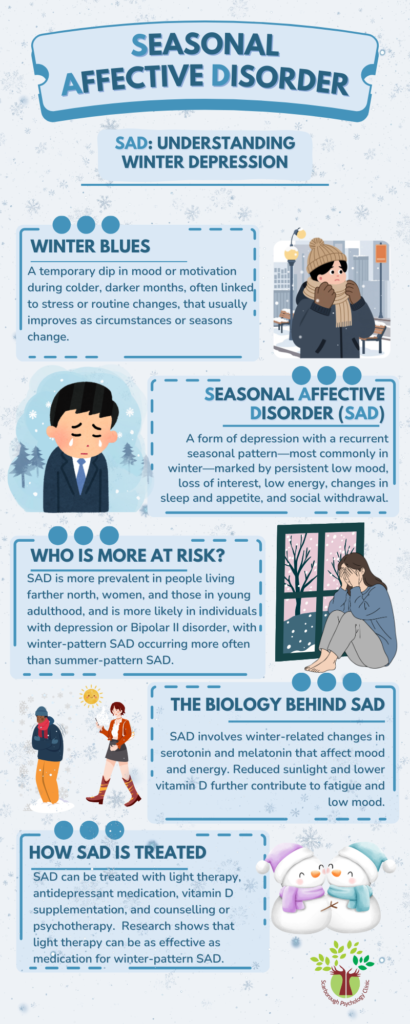
SAD, or winter depression, is a type of depression that is characterized by a recurrent seasonal pattern (NIH, 2023). The symptoms of the disorder typically last for four to five months out of the year. The symptoms are usually a mix of those associated with depression as well as disorder-specific symptoms. A few common symptoms include persistent sadness for at least two weeks, hopelessness, feelings of restlessness, loss of interest in hobbies and activities, fatigue, hypersomnia, overeating, and social withdrawal (NIH, 2023).
Seasonal affective disorder can sometimes be confused with “holiday blues,” where people may experience feelings of sadness or anxiety that is due to stress at certain times of the year (NIH, 2023). However, winter depression is due to changes in daylight hours, not the stresses that can be associated with the holiday season.
Seasonal Affective Disorder

Who is more at risk for Seasonal Affective Disorder?

The disorder appears to be more common in women than men and begins typically in young adulthood. Additionally, winter specific SAD occurs more often than summer specific SAD. As a result, seasonal affective disorder is more common in people living farther north, where daylight hours are shorter in the winter. It is also more likely in individuals with depression and bipolar II disorder (NIH, 2023).
Seasonal Affective Disorder

Scientifically, what causes SAD?

Over the years, research has proposed several explanations for why people develop SAD. One key factor involves the neurotransmitter serotonin, which plays a central role in regulating mood  (Melrose, 2015). Studies have found that individuals with seasonal affective disorder may have difficulty regulating serotonin levels (McMahon et al., 2014).

Another important component is the protein SERT, which helps transport serotonin from the synaptic cleft back to the presynaptic neuron. Higher levels of SERT can reduce serotonin activity, contributing to depressive symptoms. 

 McMahon and colleagues (2014) found that people with SAD had approximately 5% higher SERT levels during the winter months compared to summer, which may help explain seasonal mood changes.

Furthermore, the hormone melatonin also plays a key role in developing winter depression (Melrose, 2015). Melatonin is produced by the pineal gland and responds to darkness by causing sleepiness. People with seasonal affective disorder tend to overproduce melatonin (Lewy et al., 2006). Therefore, as we lose daylight sooner, melatonin production increases, causing those with SAD feel sleepy and lethargic.

Additionally, exposure to sunlight is also another factor in the disorder. Sunlight contains vitamin D, which helps in serotonin activity; therefore, vitamin D deficiency in the winter months can cause significant depressive symptoms. 

How to Manage SAD

A combination of antidepressant medications, light therapy, vitamin D, and counseling can help treat and manage winter depression (Melrose, 2015). Because the disorder is linked to serotonin regulation, SSRIs are often prescribed to help manage symptoms. However, light therapy can be a more cost-effective option and is widely recommended for managing winter depression. This therapy aims to replace the sunlight we lose during the shorter winter days, usually by using a specialized light box in the morning.

Research has shown that light therapy can be just as effective as antidepressant medication. For example, a study by Lam and colleagues (2006) compared the two treatments in individuals with seasonal affective disorder and found no significant difference in outcomes. 

Additionally, because low vitamin D levels are associated with the disorder, taking vitamin D supplements before the winter months may help prevent depressive symptoms.

If you’re experiencing seasonal mood changes, remember that you’re not alone. Help is available, and reaching out to a professional is an important first step.

Book a consultation with Scarborough Psychology Clinic —Compassionate Care for a Brighter Tomorrow.

References

Lam, R. W., Levitt, A. J., Levitan, R. D., Enns, M. W., Morehouse, R., Michalak, E. E., & Tam, E. M. (2006). The CAN-SAD Study: A randomized controlled trial of the effectiveness of light therapy and fluoxetine in patients with winter seasonal affective disorder. American Journal of Psychiatry, 163(5), 805–812. https://doi.org/10.1176/ajp.2006.163.5.805

Lewy, A. J., Lefler, B. J., Emens, J. S., & Bauer, V. K. (2006). The circadian basis of winter depression. Proceedings of the National Academy of Sciences, 103(19), 7414–7419. https://doi.org/10.1073/pnas.0602425103

McMahon, B., Andersen, S., Madsen, M., Hjordt, L., Hageman, I., Dam, H., Svarer, C., Da Cunha-Bang, S., Barré, W., Madsen, J., Hasholt, L., Frokjaer, V., & Knudsen, G. (2014). P.1.i.037 Patients with seasonal affective disorder show seasonal fluctuations in their cerebral serotonin transporter binding. European Neuropsychopharmacology, 24, S319. https://doi.org/10.1016/s0924-977x(14)70506-1

Melrose, S. (2015). Seasonal Affective Disorder: An Overview of assessment and Treatment Approaches. Depression Research and Treatment, 2015, 1–6. https://doi.org/10.1155/2015/178564

Seasonal affective disorder. (n.d.). National Institute of Mental Health (NIMH). https://www.nimh.nih.gov/health/publications/seasonal-affective-disorder#part_6692