
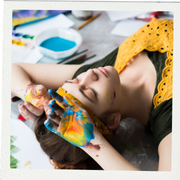
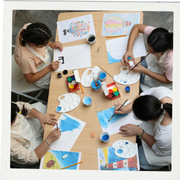
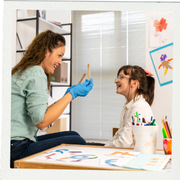
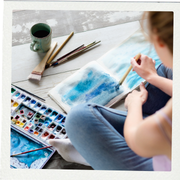
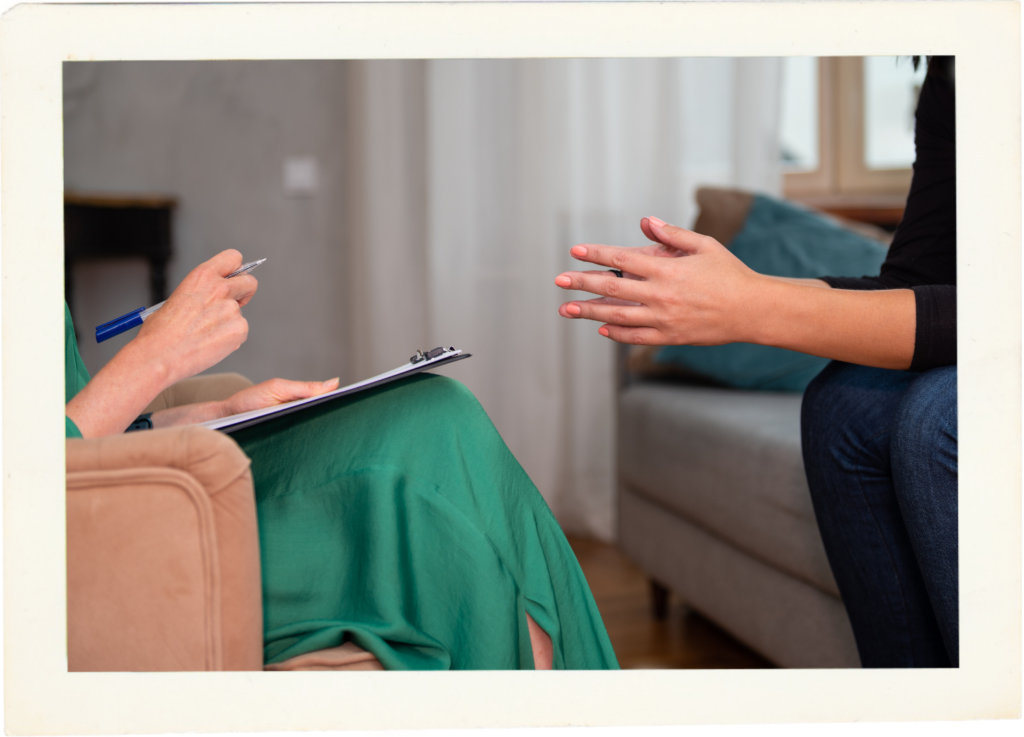
There are moments when what we feel cannot be easily put into words. A sensation lingers in the body, a memory appears as an image, or an emotion feels present but difficult to define. In these experiences, art therapy offers a meaningful way to understand and process what cannot yet be spoken.
Research across psychology and neuroscience suggests that healing does not always begin with language. Instead, art therapy allows individuals to engage with emotions through perception, imagery, and embodied experience, offering a different path toward understanding and healing (Christensen et al., 2025; Pizzolante et al., 2024).
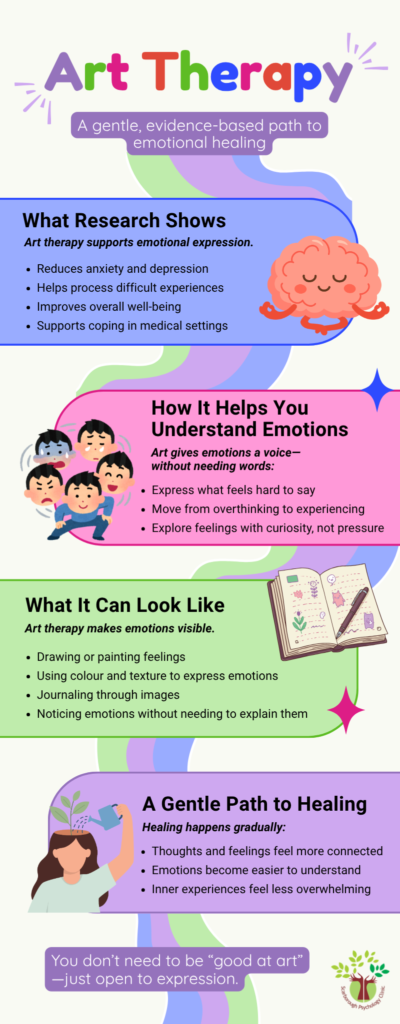
A growing body of research highlights how art therapy and creative engagement can support mental health across different populations and settings:
What connects these findings is not simply that art therapy is helpful—but that it creates a space where internal experiences can be expressed, shaped, and observed with a sense of safety and distance (Wang et al., 2025; Quinn et al., 2025).
Engaging with art is not simply a creative or recreational activity—it is also a way of thinking and understanding.
Research in the psychology of aesthetics shows that art therapy supports cognitive and emotional processing by allowing individuals to experience meaning directly, rather than translating everything into words (Christensen et al., 2025).
In this sense, art therapy functions as its own language—one that can hold complexity, contradiction, and ambiguity. It creates space for experiences that may feel fragmented or unclear, without requiring immediate explanation (Pizzolante et al., 2024).
One of the key strengths of art therapy is its ability to help individuals approach difficult emotions without becoming overwhelmed. Rather than requiring immediate explanation, art therapy allows a shift:
This is especially helpful when experiences are:
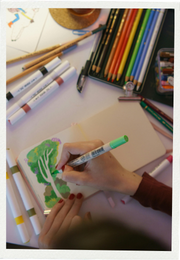
Art therapy does not require artistic skill or prior experience. The focus is not on creating something “good,” but on engaging with the process. This may include:
In therapeutic settings, guided creative processes provide structure and support, helping individuals make their experiences more accessible, more manageable, and gradually more integrated (Makkabphalanon et al., 2025; Wang et al., 2025).
The changes that occur through art therapy are often subtle. They may not feel like sudden breakthroughs. Instead, they unfold gradually:
If healing involves coming to understand ourselves in new ways, then art therapy offers a uniquely supportive path toward that understanding.
It does not require immediate clarity.
It does not demand that experiences be fully explained.
Instead, art therapy creates space—for uncertainty, for complexity, and for experiences that are still unfolding (Pizzolante et al., 2024).
If you are finding it difficult to express what you are going through, art therapy may offer a supportive and meaningful way forward. At Scarborough Psychology Clinic, we provide compassionate, evidence-based care tailored to your needs.
Book a consultation today or contact us to learn more.
Compassionate Care for a Brighter Tomorrow.
Christensen, A. P., Cardillo, E. R., & Chatterjee, A. (2025). Can art promote understanding? A review of the psychology and neuroscience of aesthetic cognitivism. Psychology of Aesthetics, Creativity, and the Arts, 19(1), 1–3. https://doi.org/10.1037/aca0000541
Makkabphalanon, K., Thangkratok, P., Bunnaphasitthasothin, C., Pramnoi, P., & Madsong, C. (2025). The effectiveness of a mindfulness-based art therapy program on sleep quality among urban older adults in Thailand: A quasi-experimental study. Patient Preference and Adherence, 19, 3183–195. https://doi.org/10.2147/PPA.S551988
Ownsworth, R., Roeloffs, S., & Zawisza, M. (2024). Creating arts and crafting positively predicts subjective wellbeing. Frontiers in Public Health, 12, 1417997. https://doi.org/10.3389/fpubh.2024.1417997
Pizzolante, M., Pelowski, M., Demmer, T. R., Bartolotta, S., Sarcinella, E. D., Gaggioli, A., & Chirico, A. (2024). Aesthetic experiences and their transformative power: A systematic review. Frontiers in Psychology, 15, 1328449. https://doi.org/10.3389/fpsyg.2024.1328449
Quinn, E. A., Millard, E., & Jones, J. M. (2025). Group arts interventions for depression and anxiety among older adults: A systematic review and meta-analysis. Nature Mental Health, 3, 374–386. https://doi.org/10.1038/s44220-024-00368-1
Svozilová, M., Kantor, J., Svobodová, Z., Smrčková, A., & Klugar, M. (2025). Effectiveness of creative arts therapies/expressive arts therapy for psychosocial outcomes in adults with oncological disease: An umbrella review protocol. Frontiers in Psychology, 16, 1570798. https://doi.org/10.3389/fpsyg.2025.1570798
Wang, J., Zhang, B., Yahaya, R., & Abdullah, A. B. (2025). Colours of the mind: A meta-analysis of creative arts therapy as an approach for post-traumatic stress disorder intervention. BMC Psychology, 13(1), 32. https://doi.org/10.1186/s40359-025-02361-4
Weir, K. (2025, September 1). What happens in the brain when we experience art. Monitor on Psychology, 56(6). https://www.apa.org/monitor/2025/09/art-mind-brain